Simple syrup is sugar dissolved in water. For a useful cocktail starting point, combine equal weights of white sugar and water: 100g of each. The resulting syrup mixes into cold drinks more readily than dry sugar, making sweetness easier to measure.
This guide uses a standard 1:1 formula by weight, with the distinction between simple and rich syrup explained in Difford’s Guide. The method has been checked against published guidance; it has not been independently kitchen-tested by Sommblog.
Ingredients and equipment
- 100g white granulated sugar
- 100g water, approximately 100ml
You need a scale, a small saucepan, a spoon and a clean food-safe container with a lid. This makes about 200g of syrup before handling or evaporation losses. It does not make 200ml: dissolved sugar changes the relationship between weight and volume.
Method
- Weigh the sugar and water into the saucepan.
- Warm gently, stirring until the sugar dissolves. A rolling boil or prolonged reduction is unnecessary.
- Remove from the heat. Let the syrup cool enough to transfer safely into the clean container.
- Label with the date and “1:1 by weight”. Refrigerate promptly once cooled and keep covered.
Allow about five minutes of active preparation, plus cooling. Avoid adding hot syrup to a drink: it warms the mixture and changes how much ice melts.
What does 1:1 mean?
Recipes sometimes use equal cups rather than equal weights. Those formulas are not identical because a cup of dry sugar and a cup of water weigh different amounts. Following one convention consistently is more useful than treating every recipe labelled “simple syrup” as interchangeable.
Write the ratio on the bottle. When a cocktail tastes too sweet, check the syrup concentration before changing the citrus or spirit measure. Our Gin Sour guide gives you a straightforward drink in which to consider that balance.
How rich syrup differs
A 2:1 rich syrup uses two parts sugar to one part water by weight, such as 100g sugar and 50g water. It is more concentrated, so substituting the same volume can change both sweetness and dilution.
For an exact arithmetic comparison by weight, 10g of 1:1 syrup contains 5g sugar and 5g water. To supply those amounts with 2:1 syrup, use 7.5g rich syrup plus 2.5g water. These are weights, not millilitre measurements or a claim that every commercial product follows the same formula.
Storage and useful variations
For a cautious household routine, make a small batch, refrigerate promptly, and use within two days or freeze in small portions. This follows the Food Standards Agency’s general leftover-handling approach; it is not a laboratory-validated shelf life for this syrup. Keep utensils clean and discard syrup showing mould or an unexpected change.
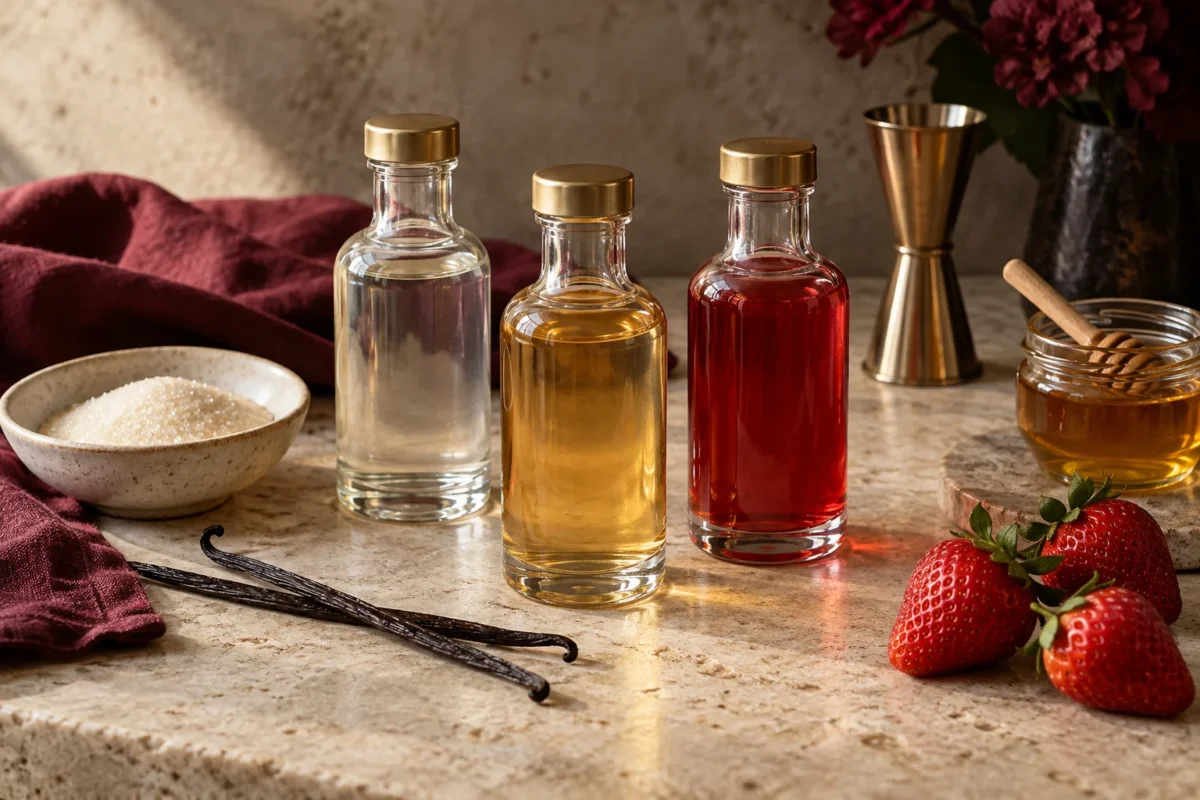
For other flavours, see vanilla syrup, strawberry syrup and honey syrup. If an ingredient is missing, our substitution guide explains what each alternative changes.
Image: AI-generated editorial illustration, not a photograph of a tested recipe or a reviewed bottle.