Tequila and mezcal are Mexican agave spirits with distinct protected identities. Tequila uses blue agave; mezcal can be made from a broader range of permitted agaves. Production traditions overlap, but a bottle labelled mezcal is not simply a smokier version of tequila.
Start with the label’s identity
You may hear that tequila is a type of mezcal. That makes sense in a broad historical discussion of agave distillates, but modern protected bottle names have separate rules. For buying and mixing, read the actual designation on the bottle rather than treating the words as interchangeable.
The Tequila Regulatory Council explains tequila’s blue-agave requirement and certification. Mezcal producer Del Maguey describes the broader agave and production differences. The important practical point is that the region, agave and producer all contribute useful information; “Mexican spirit” is not a complete style description.
Cooking and distillation influence flavour
Roasting agave in an earth pit is strongly associated with many traditional mezcals and can contribute smoke-related aromas. Tequila production often uses other cooking systems. Neither category should be reduced to a single universal piece of equipment.
Fermentation, still design, the way distillation is run and any subsequent ageing also affect the result. Smoke intensity is only one part of a mezcal’s profile. Herbal, fruit, floral, earthy and mineral-like descriptions can be just as relevant, depending on the specific spirit.
Three shortcuts to avoid
- “All mezcal is intensely smoky.” Smoke varies and may not be the dominant impression.
- “Tequila is always smoother.” Smoothness is subjective and does not identify strength, quality or category.
- “Mezcal is always artisanal and tequila is always industrial.” Production methods and scales need to be assessed producer by producer.
Price is not a reliable substitute for that information. If you are choosing a bottle for a particular drink, ask for its agave variety, production description and expected intensity. Those details are more useful than a generic premium label.
What changes when you swap them in a cocktail?
Replacing tequila with mezcal can introduce a more assertive flavour, but the extent depends on both bottles. Keep the first comparison small and measure precisely. You may need to rethink the garnish or sweetness, especially when a smoky spirit meets a delicate fruit ingredient.
Our tequila cocktail guide is written around tequila-based recipes. A mezcal substitution is a variation, not evidence that the original specification was wrong. Do not judge the whole category from one heavily mixed drink.
Does either one need salt and lime?
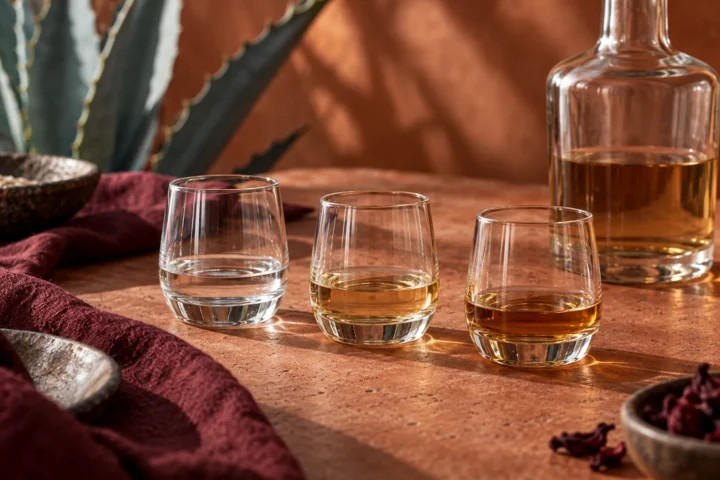
No compulsory garnish or shooting ritual is needed to understand a spirit. If tasting, use a small sample in a clean glass and give the aroma some attention. Water alongside the sample can help keep the comparison comfortable; tasting need not mean finishing every pour.
Ageing terms add another dimension to tequila, covered in blanco, reposado and añejo explained. A worm in a bottle is a separate subject altogether: read what the “tequila worm” story gets wrong. It is not a required sign of quality in either category.
Image: AI-generated editorial illustration, not a photograph of a tested recipe or a reviewed bottle.